Faith at the Water’s Edge
This week we read Parshat Beshalach.
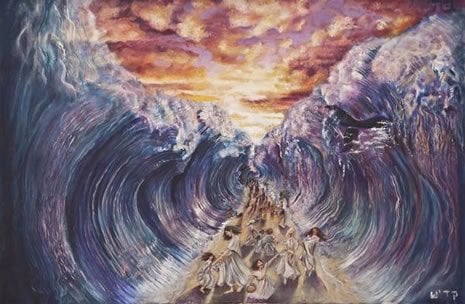
Soon after allowing the Jewish people to depart from Egypt, Pharaoh chases after them to force their return, and the Jews find themselves trapped between Pharaoh’s armies and the sea. Hashem tells Moshe to raise his staff over the water; the sea splits to allow the Jews to pass through, and then closes over the pursuing Egyptians. The Jewish nation sings a song of praise and gratitude to Hashem.
In the desert the people suffer thirst and hunger, and repeatedly complain to Moshe and Aaron. Hashem miraculously sweetens the bitter waters of Marah, and later has Moshe bring forth water from a rock by striking it with his staff. He causes manna to rain down from the heavens before dawn each morning, and quails to appear each evening.
The Jews are instructed to gather a double portion of manna on Friday, as none will descend on Shabbat. Some disobey and go to gather manna on the seventh day, but find nothing. Aaron preserves a small quantity of manna in a jar, as a testimony for future generations.
In Rephidim, the people are attacked by the Amalekites, who are defeated by Moshe's prayers and an army raised by Yehoshua.
.jpg)
Growing Like a Tree
The 15th of Shevat on the Jewish calendar—celebrated this year on Monday, Feb. 2, 2026—is the day that marks the beginning of a “new year” for trees. Commonly known as Tu Bishvat, this day marks the season in which the earliest-blooming trees in Israel emerge from their winter sleep and begin a new fruit-bearing cycle.
We mark the 15th of Shevat by eating fruit, particularly from the kinds that are singled out by the Torah in its praise of the bounty of Israel: grapes, figs, pomegranates, olives and dates. On this day we remember that “man is a tree of the field” and reflect on the lessons we can derive from our botanical analogue.
Teaching the Song
The sixth Rebbe, Rabbi Yosef Yitzchak Schneersohn, of righteous memory, relates that the Maharal of Prague instituted the custom to gather the children on this Shabbat and tell them the story of our ancestors crossing the sea.
The narrative would include the Midrashic tradition that fruit trees miraculously grew from the seabed, and the children plucked the fruits and fed them to the birds. Then the birds joined in with the singing of the Song of the Sea.
Following the storytelling, the custom was to give the children buckwheat, which they would feed the chickens and birds to commemorate their participation in the song.
Others explain that birds are “masters of song,” as no one can sing quite like the birds. Therefore, when we are going to sing G‑d’s praise, we feed the “masters of song.”

From Bitterness to Joy
Miriam the prophetess felt a deep bitterness over being in Exile and therefore experienced a far greater joy when she was redeemed. So too today, according to the depth of our bitterness in exile will be the magnitude of our joy in Geulah.
The Song of the Birds
Several years ago, we lived in Modi’in. The back of my laundry room faced the parking lot, and I noticed that a flock of small birds would congregate each morning and look for food. “What can they find in a paved parking lot?” I asked my husband.
I took a slice of old bread, broke it into several small pieces and threw it out to the birds. Their initial reaction was to fly away, but a minute or two later, they returned and pecked at the bread.
So started my daily routine of feeding the birds. Early each and every morning, I would open my window wide, call “birdies,” throw out my pieces of bread, and before I knew it my “bird friends” were pecking away.
After a while, the bird population in my parking lot grew. It was as if the small birds told their friends and neighbors how to get free and easy food. It was amazing to see nature at work.
I remember thinking, “Is this what it was like, when the Jews were walking through the desert and their only food was the manna that fell from the sky each night?” Waiting and looking for your daily ration is a humbling experience.
Like the birds, we are dependent on G‑d for our needs. Today, manna doesn't fall from the sky. We need to work to provide for ourselves and our families, but it is G‑d who decrees our livelihood. He is our Father in the Heavens watching over us, and we are His children. He knows our joy; he knows our pain. He is always with us.
We now live in Netivot. The birds congregate behind our apartment. Now it is my husband who feeds the birds. One day, a neighbour of ours, who happens to be a rabbi, saw my husband scattering the bread. He asked him what he was doing and when my husband said that he was feeding the birds, the rabbi told him that feeding the birds was a very important mitzvah.
On this Shabbat we, too, sing praise to G‑d.
He reminded my husband that on the Shabbat on which the Torah portion of Beshalach is read, which is known as Shabbat Shira, one of the customs is to place crumbs outside for the birds to eat.
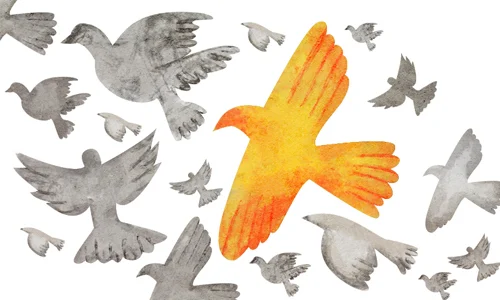
The chirping of birds is not just idle noise. It is the way that birds praise Hashem for providing them with their needs. Because on this Shabbat we, too, sing praise of our Creator, we recognize the constant song of praise chirped by the birds and reward them by feeding them.
After four years, on the last day that we lived in Modi’in, I finished throwing out my pieces of bread and I asked my husband, “Who will feed the birds tomorrow?”
He told me not to worry. They’ll be fed.