Passing the Blessing
The name of the Parshah is Vayechi.
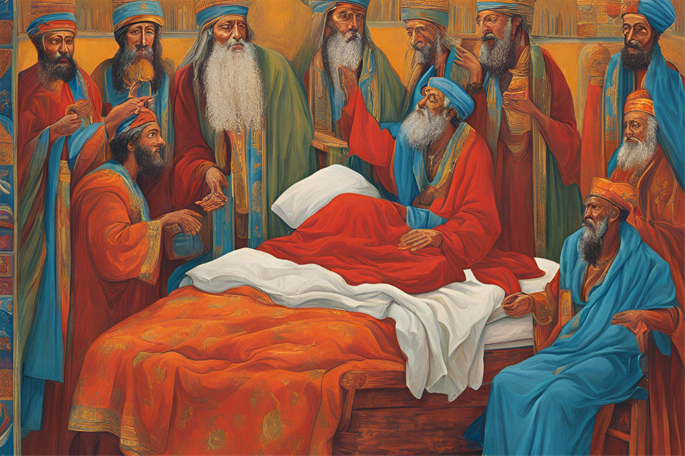
Yakov lives the final 17 years of his life in Egypt. Before his passing, he asks Yosef to bury him in Israel. He blesses Yosef’s two sons, Menashe and Ephraim.
Yakov blesses his sons, assigning to each his role as a tribe.
A large funeral procession consisting of his descendants, Pharaoh’s ministers, the leading citizens of Egypt and the Egyptian cavalry accompanies Yakov to his burial in Chevron.
Yosef, too, dies in Egypt, at the age of 110.

Ending Strong
Parshat Vayechi is the last section in Chumash Bereishit, the first volume of the Torah.
The custom in Ashkenazic communities is that at the conclusion of each of the fives volumes, the congregation stands and calls out “Chazak, chazak, venitchazek!” (“Be strong, be strong, and we will be strong!”), and then the one reading the Torah repeats that phrase. In most Sephardic congregations the custom is to say “Chazak ubaruch” (“Be strong and blessed!”) at the conclusion of every aliyah to the Torah.
The Talmud tells us that one of the things that is in constant need of “bolstering” and improvement is Torah study. Thus, we say “Chazak” to strengthen ourselves in Torah study.
It’s crucial to review the Torah we’ve learned so as not to forget it. This is why, after finishing a portion of the Talmud, we say “Hadran alach,” “I will return to you.” Similarly, when we finish a book of Torah, we say “Chazak,” in other words, “We should have the strength to review what we learned.”
Strength in Learning Together
The daily Chassidic thought on Friday written by the Chabad Rebbe is:
The Mitteler Rebbe answered someone at yechidus: When two discuss a subject in divine service and they study together, there are two Godly souls against one natural soul.
Why the End Remains Hidden
Rashi quotes a well-known Midrash, also cited in the Talmud, which teaches that Yakov wished to reveal the date of the Moshiach, but the Divine Presence withdrew from him and he began to speak of other things. Hashem did not want us to know the date of the final redemption because it would discourage us, during our divine service, to hasten its coming.
Building Torah from the Ground Up
My parents, Rabbi Sholom B. Gordon and Rebbetzin Miriam Gordon, of blessed memory, were sent to Newark, N.J., by the Sixth Rebbe in 1948. My father initially spent three years there starting in 1942, while still single. After my parents’ marriage, they were assigned to a new position in Springfield, Mass., and later reassigned to Newark, where I was born and raised.
My father drove me to a Jewish day school in a nearby city every day, hoping I would receive a solid Jewish education. In the early days of first grade, I returned home one day, and my father inquired, “So, are you learning Chumash? Are you learning Torah?” At six years old, I candidly replied, “I’m sorry, but we don’t learn Chumash in our school.”
Confused, my father asked, “You don’t learn Chumash? What, then, are you learning?”
“We have a reader,” I explained, “and we learn stories about Yossi Pessi!”
Perplexed, my father asked, “Who’s Yossi Pessi?”
“These are made-up stories about a kid named Yossi,” I elaborated. “Yossi is a ‘pessi,’ which is Hebrew for idiot. The stories we read are about all of the silly and foolish things Yossi does and all the trouble he gets himself into.”
My father was incredulous. “For this I drive all those miles each day?” he exclaimed. “For this I pay tuition? So you can read and learn about Yossi Pessi?! I’m not happy about this.”
Subsequently, he scheduled a meeting with the head of school and expressed his concerns about the curriculum. “My dear rabbi,” said my father, “with great self-sacrifice, I drive a long distance and I pay my fair share of tuition to send my son to your school, so that my child can study Torah. Yet, instead of learning Chumash, my child is learning about Yossi Pessi – Yossi the Idiot – some fictional character who is always getting into trouble. That’s the workbook. That’s what the school is teaching my son. Why would the school do that, dear rabbi?”
The head of school looked at my father, shook his head back and forth, and said, “Ah, today everybody is an educator. Everybody thinks they know about education.” He was basically telling my father that if he had wanted advice on how to run his school, he would have asked for it.
My father thanked the rabbi very much, drove home, and immediately started a cheder in Newark. He made a few phone calls, knocked on some doors, took a few kids out of public school, and just like that he started a new school, where I spent many years with my father as my teacher.
I can honestly say that had my father not done so, and had I not merited to become my father’s student for all those years, not only would I lack the knowledge I accumulated, but I would also be without the passion that I have for the teachings of Chassidus and Torah. This personal experience vividly illustrates the importance of establishing Torah infrastructure anywhere and everywhere that Jews find themselves.
Yehoshua B. Gordon