Wrestling, Wounds, and a New Name
The name of the Parsha is Vayishlach.
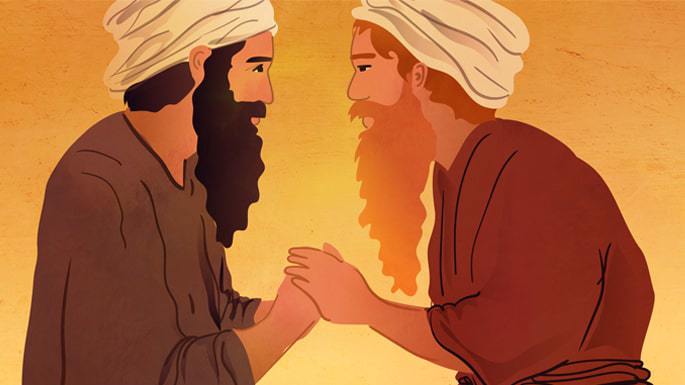
Yakov returns to the Holy Land after a 20-year stay in Charan, and sends angel messengers to Esav in hope of a reconciliation, but his messengers report that his brother is on the warpath with 400 armed men. He prepares for war, prays, and sends Esav a large gift to appease him.
That night, Yakov ferries his family and possessions across the river, however, he encounters Esav’s angel, with whom he wrestles until daybreak. Yakov suffers a dislocated hip but wins. He receives his name Yisroel.
Yakov and Esav meet, embrace and kiss, but part ways. Yakov journeys on. Rachel dies while giving birth to her second son, Binyamin, and is buried in a roadside grave near Beth Lechem.
The Birth of Chassidus
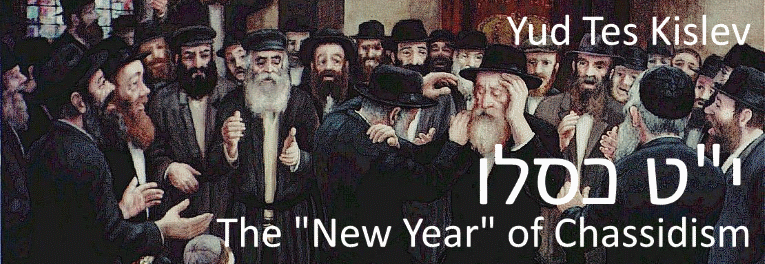
The 19th of Kislev is celebrated as the “Rosh Hashanah of Chassidism.” It was on this date, in the year 1798, that the founder of Chabad Chassidism, Rabbi Schneur Zalman of Liadi was freed from his imprisonment in Russia. More than a personal liberation, this was a watershed event in Jewish history, heralding a new era in the revelation of the “inner soul” of Torah.
Rabbi Schneur Zalman went much farther than his predecessors, bringing these teachings to broader segments of the Jewish population of Eastern Europe. More significantly, Rabbi Schneur Zalman founded the “Chabad” approach, that made these abstract concepts rationally comprehensible and practically applicable in daily life.
In the fall of 1798, Rabbi Schneur Zalman was arrested on charges that his teachings and activities threatened the authority of the czar, and was imprisoned in an island fortress in Petersburg. In his interrogations, he was compelled to present to the czar’s ministers the basic tenets of Chassidism. After 53 days, he was exonerated of all charges and released.
Rabbi Schneur Zalman saw these events as a reflection of what was transpiring Above. He regarded his arrest as but the earthly echo of a heavenly indictment against his revelation of the most intimate secrets of the Torah. And he saw his release as signifying his vindication in the heavenly court. Following his liberation on 19 Kislev, he redoubled his efforts, disseminating his teachings on a far broader scale, and with more detailed and “down-to-earth” explanations, than before.
This day marks the “birth” of Chassidism, when the long-hidden secrets of Judaism emerged from the womb of mysticism to illuminate and transform the totality of Jewish life
Chabad.org

Jacob’s Message to Esau
Upon learning that his wicked brother, Esau, was heading his way, what message did Jacob send? “I’ve been living with Laban!”
What was Esau supposed to do with that information?
The answer lies in Rashi’s commentary, which encourages us to read between the lines. Jacob said, “Im Lavan garti – I lived with Laban.” The Hebrew word garti has the numeric value of 613, representing the 613 commandments in the Torah. This was Jacob’s message to Esau. “I lived in the house of Laban. I lived in the city of Aram Naharayim, where everyone is morally bankrupt and wicked. And even there, I kept all of Torah’s laws. I did not adopt Laban’s evil ways. I didn’t compromise even one iota of my Jewish way of life.”
But why would Esau be impressed that Jacob remained faithful to the Torah?
The explanation lies in the fact that Esau wanted to do more than just eliminate Jacob; he wanted to annihilate the Jewish people. He intended to make sure that there would be no Children of Israel. A deeper conversation was unfolding. Esau, from whom the Roman Empire descended, was saying to Jacob, “I am going to kill you. And without you, your children will grow up to be good Romans.”
And Jacob responded, “You won’t kill me, and you won’t influence my children. You may be a superior warrior, but I’m a tougher guy! I lived with Laban. I lived in a hotbed of immorality, and yet, look at the children I raised there—nice Jewish kids! Each of my sons wears a kippah. My daughter lights Shabbat candles
Yehoshua b. Gordon
Freedom to Do More
Unlike throughout most of Jewish history, Jews today can freely practice Yiddishkeit anywhere in the world. This freedom is a gift and opportunity, placing the responsibility on us to use it to spread Torah and Mitzvos as much as we can. This is a preparation for the Geulah, when Moshiach will bring the entire world to know Hashem.
A Blessing on the Neva River
After his arrest, Rabbi Shneur Zalman was at once escorted to the secret cells of the dread Peter-Paul fortress in St. Petersburg, where he was to spend over seven weeks until his miraculous release on the 19th (Yud-Tet) of Kislev, 1798. For the first three weeks he was held under the severe conditions which were the lot of those impeached for rebellion against the Czar.
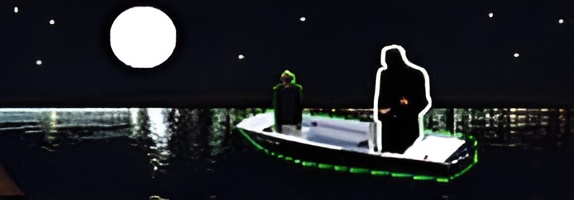
This interrogation took place not there, but in the headquarters of the Tainy Soviet, the Secret Council on the other side of the Neva River, so that the Rebbe had to be taken across each time by ferry.
On one such occasion, the Rebbe asked the gentile official accompanying him to stop the ferry so that he could stand and recite Kiddush Levana, the blessing recited over the New Moon. He refused, whereupon the Rebbe said, "If I want to, I can stop the boat myself."
And indeed, after the man again refused to oblige, the boat stopped in the middle of the river. The Rebbe then recited the verses of Psalm 148, which are said before the blessing over the moon, but did not pronounce the blessing itself. The ferryman realized that unusual forces were at work. He begged the Rebbe to release the boat. The ferry then proceeded on its way.
When the Rebbe again asked the official to stop the boat, he asked: "What will you give me in exchange for the favor?"
In reply, Rabbi Shneur Zalman gave him a blessing. The man then demanded it in writing, and the Rebbe recorded it on a note in his own handwriting.
In later years, when that official rose to a position of power and enjoyed an old age of honor and prosperity, he treasured that note, which he kept under glass in a heavy gold frame. Indeed, it was seen and read by a renowned disciple of the Rebbe by the name of Rabbi Dov Zev, who, before he was appointed rabbi of the Chasidic community in Yekaterinoslav, lived in Stradov, where he was given the main responsibility of teaching Chasidic philosophy and the guiding chasidim in observance and self-refinement. He had heard from an aged chasid that there lived a gentile squire not too far from Stradov who was the son of the official who had received that written blessing from Rebbe Shneur Zalman halfway across the River Neva. The son too revered the note in the frame, he said. Hearing this, Rabbi Dov Zev made it his business to locate that nobleman, and was thus able to see the note.
One year on the 19th of Kislev, on the anniversary of Rabbi Shneur Zalman's release, Rabbi Yosef Yitzchak related the above episode and added that as a boy he had been left with a question. Since the Rebbe had already stopped the boat, why did he not recite the blessing as well, and then he would not have to depend on the favor of the gentile? When he had grown older, he continued, and had grasped the approach of Chasidism more profoundly, he understood that here was a point of principle involved. The Rebbe had been obliged to act as he did, for a mitzvah is made to be performed only when it is clothed in the ways of nature, and not through supernatural miracles.