Built by the People
This week we read two Parshiot; Vayakhel and Pekudei.
The Jewish people donate the required materials for the Mishkan in abundance. Moshe has to tell them to stop giving.
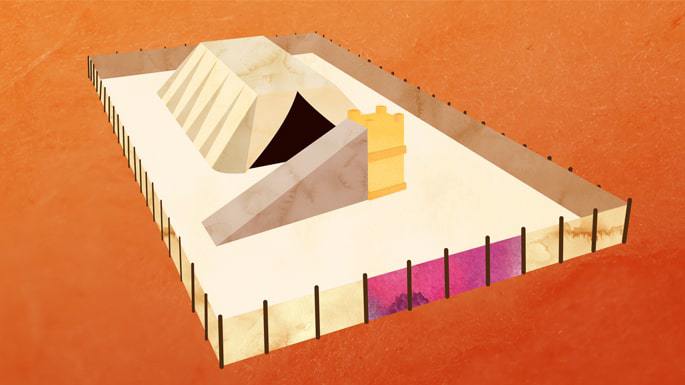
A team of artisans make the Mishkan and its furnishings: three layers of roof coverings; 48 gold-plated wall panels, and 100 silver foundation sockets; the veil that separates between the two chambers, the ark, and its cover; the table and its showbread; the seven-branched menorah with its specially prepared oil; the golden altar and the incense burned on it; the anointing oil; the outdoor altar for burnt offerings; and the basin, made out of copper mirrors.
An accounting is made of the gold, silver and copper donated by the people for the making of the Mishkan. Betzalel, Aholiav and their assistants make the eight priestly garments.
The Mishkan is completed and all its components are brought to Moshe, who erects it and anoints it with the holy anointing oil, and initiates Aaron and his four sons into the priesthood. A cloud appears over the Mishkan, signifying that Hashem has come to dwell within it.

Nissan Begins with Miracles
On Wednesday and Thursday we celebrate Rosh Chodesh Nissan. The beginning of the month of our redemption from Egypt. In a different way of counting the months, Nissan is the first month of the Jewish calendar since it marks the birth of the Jewish people as a nation.
The word Nissan means miracles, showing us that this is a month of miracles, until today. The first of Nissan is also the day that Hashem descended on the Mishkan to rest on it.

Blessing the First Blossoms
If one sees a budding fruit tree during the month of Nisan, there is a special blessing to be said: “Blessed are You … Who has made nothing lacking in His world, and created in it goodly creatures and goodly trees to give mankind pleasure.” Many people visit botanical gardens during this time, so as to avail themselves of an opportunity to observe this beautiful mitzvah.

Breaking Every Barrier
Joy breaks through all barriers. This reflects the nature of Moshiach, who descends from a man named Peretz (according to the Gemara). Peretz means to break through. Moshiach will break through all boundaries and limitations that confine us in exile.

Simple Prayers, Highest Place
One day, the Baal Shem Tov arrived at a small crossroads inn, many miles distant from the nearest Jewish community. He was warmly invited in, and served a refreshment by the innkeeper's family. "Where is your father?" he asked the children. "He's praying," they replied, and Rabbi Israel settled down to wait for his host.
An hour passed, then two. It was late afternoon by the time the innkeeper emerged from his room. After greeting his guest, he apologized for his long absence. "I am an ignorant Jew," he explained shamefacedly. "I can barely pronounce the words from the prayerbook, and deciphering its instructions, written in vowel-less Hebrew, is beyond me. So I have no choice but to recite the entire prayerbook, from cover to cover, every day."
"Perhaps I can be of assistance to you," said Rabbi Israel. For the next hour, he sat with the innkeeper, patiently instructing him on the proper use of the prayerbook. On small slips of paper, Rabbi Israel wrote out, in simple Yiddish, "morning prayers," "special addition for Mondays and Thursdays," "grace after meals," "afternoon prayers," "evening prayers," "for Shabbat," "for Rosh Chodesh," "for Rosh Hashanah," and so on, and inserted them to mark the proper place in the innkeeper's prayerbook. "Thank you so much," said the innkeeper, when Rabbi Israel took leave to resume his journey. "Now I can begin to pray like a proper Jew."
But the innkeeper's joy was short-lived. Later that day, the prayerbook inexplicably fell from its shelf, and every last slip of paper inserted by the Baal Shem Tov fluttered from its pages. "Woe is me!" cried the innkeeper. "Who knows how many months will pass until a learned Jew will again come this way?" Determined not to let this opportunity to begin praying properly escape him, he grabbed the prayerbook and the notes and ran off in the direction that his guest had gone.
After several miles of brisk walking, he finally sighted the Baal Shem Tov far ahead. From the distance he saw Rabbi Israel reach a river. "How will he cross?" wondered the innkeeper,"This time of year, the water is too deep and swift to ford." He was about to shout a warning, when he saw Rabbi Israel spread his handkerchief on the water, step onto it as if it were the sturdiest of rafts, glide smoothly across, and disappear into the woods on the opposite bank.
In a flash, the innkeeper was at the water's edge. Spreading his handkerchief on the water, he stepped onto it and glided across, and ran down the path Rabbi Israel had taken. "Wait, Rabbi!" he called. "Wait! You cannot go until you mark my prayerbook again! All your notes have fallen out!"
Hearing the man calling out to him, Rabbi Israel stopped and turned, to see his recent host running toward him, clutching his prayerbook in one hand and the slips of paper in the other. "How did you get here?" asked Rabbi Israel in amazement. "How did you cross the river?"
"With my handkerchief, same as you," replied the simple Jew. "By the way, that's some trick you've got there. I never would've thought it could be done that way."
"I think," said the Baal Shem Tov slowly, "that G‑d is extremely satisfied with your prayers as they are. Perhaps you should continue to pray just the way you have up until now."