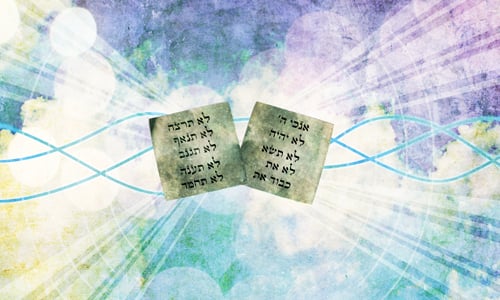
Law and Commitment
The name of the Parshah is Mishpatim.
Following the giving of the 10 commandments, Hashem commands the Jews with a series of laws. These include the laws of the indentured servant; the penalties for murder, kidnapping, assault and theft; civil laws pertaining to redress of damages, the granting of loans and more. Altogether, the Parshah of Mishpatim contains 53 mitzvot—23 positive commandments and 30 prohibitions.
Hashem promises to bring the Jewish people to the Holy Land and warns them against assuming the pagan ways of its current inhabitants.
The Jews proclaim, “We will do and we will hear all that Hashem commands us.” Leaving Aaron and Hur in charge in the Israelite camp, Moshe ascends Mount Sinai and remains there for forty days and forty nights to receive the Torah from Hashem.

Increase the Joy
On Wednesday we celebrate Rosh Chodesh Adar. “When Adar arrives, increase in joy”. This is a commandment of the Gemara. Because Purim is such a joyous day, we carry its joy throughout the entire month in anticipation for the holiday. We begin dancing to Purim songs, preparing costumes and feeling the festivities. Ada is a month of good fortune for the Jewish nation.

The Power of the Half-Shekel
Half a shekel (the money in Biblical times) was given annually in the times of the Beit Hamikdash by every Jewish male over the age of twenty.
These contributions were used to purchase the sacrifices offered every day.
Starting the first day of the month of Nissan, only sacrifices purchased with the new yearly contributions could be offered. So that Jews would have enough time to bring their half-shekel for that year, proclamations were made on the first of Adar — a month in advance — reminding people to bring their half-shekel before the first of Nissan.
After the destruction of the Beis HaMikdosh, when it is no longer possible to fulfill the mitzvah of giving the half-shekel, the reading of the parshah in the Torah about the half-shekel substitutes for the actual giving.
Turning Decree into Deliverance
The half Shekel that the Jews gave each year, annulled in advance the decree Haman made against the Jews, for which he used money to bribe the king. The idea of the half-shekel as it relates to the future was that through it, Haman’s evil decree was annulled, and the miracle of Purim came to pass. Purim is the celebration of a potential tragedy that was transformed into a joyous festival. This corresponds to the service of transforming the darkness of exile into the light of the future redemption.
A Minyan in the Desert
This week in the Parsha, the Jews began their travels in the desert. The following is a moving story that took place in the desert thousands of years later.
It was the year preceding 9/11, and I was serving in the Kazakhstan desert as a major in the U.S. Army Reserve. We were tasked to train our Kazahk, Uzbek and Kyrgyz allies to fight an Al Qaeda terrorist group called the IMU.
It also happened to be my father's yahrtzeit the next day, which was a Friday. Having never missed an opportunity to recite the kaddish for either of my parents I was extremely distraught. I prayed to G‑d with all my soul and might, asking for a miracle to deliver me from this desert to a synagogue with a suitable minyan.
An hour later, a small car pulled up and stopped directly in front of me. A Kazakhstan colonel exited the vehicle and greeted me cheerfully. The previous year he had been in Tampa at MacDill Air Force Base, and I was his assigned escort officer. He had remembered the VIP treatment he had received and sought me out to thank me.
When he asked me if there was anything he could do for me, I decided to make a seemingly impossible request: to visit a synagogue the very next evening. The colonel’s interpreter shockingly replied, "Yes! He knows of such a place! He will meet you here tomorrow morning and take you there by the afternoon.”
I immediately visited the operations center to inform them of my trip and request a pass. While there, I spoke with a rather secular Jewish army captain and asked him to join me. Eager to leave the desert, he agreed to attend services. Testing the limits of my senior officer's rank was an added incentive for him to attend the service.
After a rather lengthy five-to-six-hour bumpy journey, we arrived at the then capital city of Almaty. A beautiful and impressive synagogue appeared before us as though it had fallen from the sky. It had quite a presence in those surroundings.
When we stood in the doorway of the synagogue in our uniforms, the concerned looks on the faces of the rabbi and congregants slowly dissipated as we joined them in prayer. Ironically, the army captain who was coerced into attending was the tenth man to arrive, thereby completing the minyan.
Afterwards, the Kazakhstan colonel, whom I later learned had served in the KGB, donned a kippah and joined us for a Shabbat meal. After Shabbat, we prayed at the gravesite of Rabbi Levi YitzchakSchneerson, the Rebbe’s father.
Since then, I have retired from the army, and I have never missed a yahrzeit. But I will always remember this special one in Kazakhstan.
Robert Metnick