Building a Place for Holiness
The name of the Parsha is Terumah.
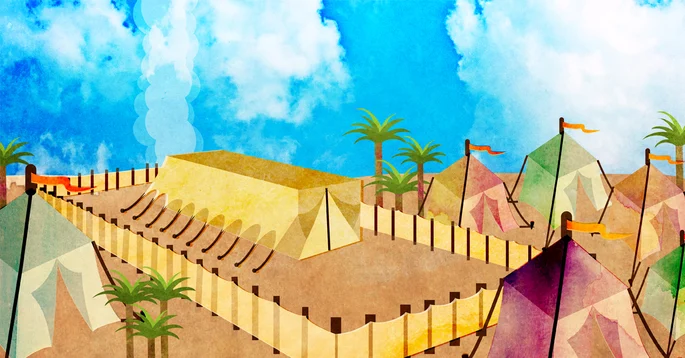
The people of Israel are called upon to contribute thirteen materials with which to build the Mishkan, the Sanctuary.
Moshe is given detailed instructions on how to construct this dwelling so that it could be readily dismantled, transported and reassembled in the desert.
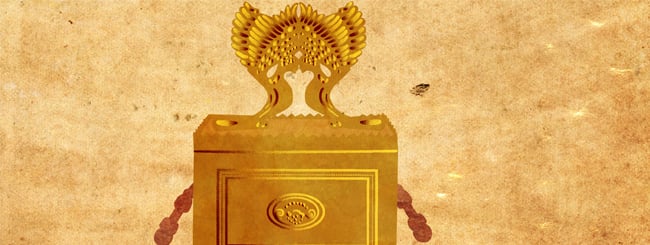
In the Sanctuary’s inner chamber, behind a curtain, was the ark containing the tablets with the Ten Commandments; on the ark’s cover stood two-winged figures. In the outer chamber stood the menorah and the table upon which the “showbread” was arranged.
The Sanctuary’s three walls were fitted together from 48 upright wooden boards, each of which was overlaid with gold and held up by a pair of silver foundation sockets. The roof was formed of three layers of coverings. Across the front of the Mishkan was an embroidered screen held up by five posts.
Surrounding the Sanctuary and the copper-plated altar which fronted it was an enclosure of linen hangings, supported by 60 wooden posts with silver hooks and trimmings, and reinforced by copper stakes.

America Is No Different
The previous Chabad Rebbe, Rabbi Yosef Yitzchak Schneersohn, reached the shores of the United States on the 10th of Adar of 1940 (5700). Upon arrival, he declared “America is nisht andersh!” (“America is no different!”). He was determined that the same Judaism for which he had risked his life in Communist Russia would thrive in America.
Gold Inside and Out
The Ark was holy. It contained the Tablets given to Moshe at Har Sinai. This verse reminds us that sanctity expresses our inner values in an outward manner. Like the Ark, which was gold inside and out, our actions should correspond to our beliefs. The saying “do as I say, not as I do” is the antithesis of a sanctified life.
Just like the Ark and its contents, our bodies and souls are G‑d-given, and it is our responsibility to keep them safeguarded and sanctified.
This parallel is symbolic and powerful. Each of us can be seen as a dwelling place for G‑d if, by our own efforts, we strive to make it so. The fusion of body and soul can help increase inner and outer harmony. The gold on the inside and on the outside of the Ark reminds us to be genuine and authentic.
Katia Bolotin

A Life Fully Dedicated
Nowadays, all people; Jews and non-Jews and even Torah sages must spend time earning a living. When Moshiach comes, we won’t need to make any effort to earn a livelihood, and all our time will be used to know Hashem.

The Value of Effort
“Why do a mitzva if I know I will sin afterward?”
A visitor once asked this blunt question to the Rebbe in a private audience. He understood that performing a good deed is meaningful but thought that any merits gained would be wiped away upon sinning.
“Imagine a breathtaking scenic landmark,” the Rebbe began. “A tourist captures the view with a photograph, and frames it beautifully. How much would the photograph sell for?” the Rebbe asked.
The man answered hesitantly, “About twenty-five dollars?”
The Rebbe continued his metaphor: “Another tourist who is an accomplished artist sees this magnificent sight and skillfully paints the scene. How much would his original artwork sell for?”
“Oh, it could be several thousand dollars!” exclaimed the man.
“Logically,” the Rebbe explained, “the painting, despite its beauty, only captured several of the many details in the entire scene. The photograph, on the other hand, captured every detail of the landmark.
“Why is the painting worth more than the photograph?” the Rebbe asked.
The man, comprehending the Rebbe’s parable, quickly replied, “It’s the effort that counts!”
“Exactly!” the Rebbe concluded. “Angels are picture-perfect. Though they do not sin their perfection does not require effort. Humans are imperfect. We may make occasional mistakes, but our effort is very precious to G‑d.